Advanced Java Spring Boot Ecosystem: Implementing Dependency Injection, Spring Security with JWT, and Spring Data JPA for Enterprise Grade Backend Stability

Modern backend systems need to be secure, maintainable, and resilient under real business load. In the Java world, Spring Boot has become a preferred choice for building enterprise APIs because it offers strong conventions, mature security options, and reliable data access patterns. When you combine dependency injection for clean architecture, JWT-based security for stateless authentication, and Spring Data JPA for structured persistence, you get a backend foundation that scales well across teams and environments.
This article explains how these pieces fit together and how to implement them in a practical, production-ready way, without overcomplicating the design. Learners often practise these patterns while pursuing a full stack developer course in pune to build stable REST APIs used in real projects.
Dependency Injection for Clean and Testable Architecture
Dependency injection is a design approach where your classes receive the objects they depend on, instead of creating them directly. In Spring Boot, the IoC container manages object creation and wiring automatically. This reduces tight coupling and makes your code easier to test and extend.
Why DI matters in enterprise services
A typical enterprise API has layers such as controller, service, repository, and integration clients. Without DI, each layer might create its own dependencies, leading to rigid code and repeated configuration. With DI, you clearly define responsibilities:
- Controllers handle request validation and response shaping
- Services handle business rules and transaction boundaries
- Repositories handle data access
- Clients handle external API calls
Recommended DI practices in Spring Boot
Constructor injection is the preferred style because it makes dependencies explicit and supports immutability. It also improves testability because you can pass mocks easily in unit tests. Use interfaces when you expect multiple implementations, such as payment gateways or notification channels. Keep beans focused and avoid large service classes that mix unrelated responsibilities.
When done correctly, DI supports a modular codebase where changes in one area do not break unrelated features.
Spring Security with JWT for Stateless Authentication
Enterprise applications must protect APIs against unauthorised access and implement role-based restrictions. Spring Security is powerful, but it is important to configure it with clarity so the security flow remains understandable for the team.
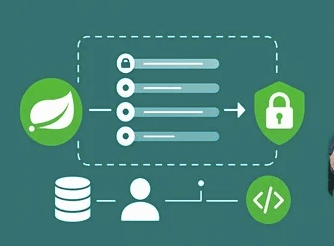
JWT, or JSON Web Token, is commonly used for stateless authentication. Instead of storing sessions on the server, the server verifies a signed token on each request. This aligns well with microservices and horizontal scaling, as each instance can validate requests without shared session storage.
Key components of a JWT security flow
A standard flow includes:
- User logs in with credentials
- Server validates credentials and issues a signed JWT
- Client stores the token securely and sends it in the Authorisation header
- Server validates token signature, expiry, and claims on every request
- Access is granted based on roles and permissions
Practical Spring Security setup points
In Spring Boot, you usually create a security configuration that:
- Permits public endpoints such as login and health checks
- Requires authentication for protected routes
- Adds a JWT filter that extracts and validates the token
- Sets authentication in the security context after validation
- Uses role-based rules for admin and user endpoints
For production, keep tokens short-lived, rotate signing keys if needed, and use refresh tokens carefully. Also, ensure passwords are hashed using a strong encoder such as BCrypt. Never log tokens, and validate expiry strictly to reduce risk.
See also: Transform Your Connectivity: Discover the Advantages of Syrotech Dual-Band ONT
Spring Data JPA for Reliable Data Access
Most enterprise backends depend on stable persistence. Spring Data JPA provides an abstraction layer over JPA and Hibernate, helping teams implement repositories consistently while avoiding boilerplate SQL for common operations.
Why Spring Data JPA works well in teams
JPA entities represent domain data, repositories provide CRUD operations, and services control business logic. With Spring Data JPA, you can use method naming conventions for simple queries and switch to JPQL or Criteria APIs when queries become complex.
Common patterns include:
- Repository interfaces extending JpaRepository
- Pagination and sorting for large datasets
- Auditing fields such as createdAt and updatedAt
- Transactions controlled at the service layer
Avoiding common JPA pitfalls
To keep performance predictable, use fetch strategies thoughtfully. Lazy loading is safe by default, but you should design APIs to avoid unexpected N+1 query issues. Use DTO projections for read-heavy endpoints rather than returning large entity graphs. Index frequently searched columns, and be careful with cascading rules so you do not accidentally delete related data.
Putting It Together for Enterprise Grade Stability
Dependency injection, JWT security, and JPA are not isolated features. They work best when aligned with clean architecture and operational practices.
A typical enterprise-ready backend design includes:
- Clear separation between controller, service, and repository layers
- Central exception handling using controller advice
- Validation using annotations for request payloads
- Logging with correlation IDs for tracing requests
- Environment-based configuration for database and security keys
- Automated tests covering service logic and security rules
Stability also comes from consistency. Teams should standardise response formats, error codes, and role naming. Security rules should be documented and reviewed. Database migrations should be automated using tools like Flyway or Liquibase so environments do not drift.
Many developers practise these implementation habits while building portfolio projects during a full stack developer course in pune, because recruiters often evaluate how well your backend code is structured, secured, and maintainable, not only whether it works.
Conclusion
The Spring Boot ecosystem becomes enterprise-grade when you apply its core building blocks correctly. Dependency injection helps you build clean, testable modules. Spring Security with JWT provides scalable stateless authentication with strong access control. Spring Data JPA gives a reliable persistence layer that supports team development and long-term maintainability. When these parts are combined with good layering, validation, and operational discipline, your backend gains the stability needed for real-world business systems.